A compact, portable and economical
high power inductive energy storage generator - development and application -
HEIBE
Funding: INCO COPERNICUS� Project: ERB-IC15CT970705
Coordinator:
Ecole
Polytechnique, Laboratoire de Physique des Milieux Ionis�s, Palaiseau, France,
Project manager: Dr. Peter Choi
Partners:
Ecole Polytechnique, Laboratoire de Physique des Milieux Ionis�s,
Palaiseau, France, Project responsible: Dr. Jean Larour
Trinity College, Dublin University, Ireland.
IR Project manager: Professor James Gerard Lunney
Loughborough
University of
Technology - LUT, U.K., UK project manager: Professor Ivor Ramsay Smith
INOE 2000, Magurele,
Romania, RO Project manager: Dr. Viorel Braic
High Current
Electronics Institute, Russia, RU Project manager: Dr.
Alexander Kim
INOE
PARTNER
I.
Objectives and planned actions
1.
very low ion energy ion assisted TiN thin films deposition by magnetron sputtering
� plasma
study (noble gas addition)
� film
deposition and characterisation
2.
development of a cathodic arc ion
assisted hard coating deposition system (closer to the industrial application
than magnetron sputtering system)
3.
hard coating (TiN)
deposition of electrodes for HEIBE system
4.
collection of information for data
base
5.
Life time increasing of highly
stressed electrodes of HEIBE power pulse generator by surface coating with hard
nitrides (TiN, TiAlN)
v electrodes
design, manufacturing and coating
v electrodes
tests on high power pulse generator
v surface
wear/damage investigation
v design
of optimised coatings for power pulse generator electrodes
6. Design and manufacturing of a
substrate holder for the working chamber manufactured in the first year. The
substrate holder has to provide different ion exposure angles, temperature
measurement and regulation, ion current measurement.
II.
Contribution of the partner
�Point 1
is our �traditional� field of activity and a comparison between the already
�classical� surface processing technologies as magnetron or plasmatron
thin films deposition and the newest aproaches
dealing with energetic ions to design new thin film deposition or surface
modification technologies has to be made.
Related to point 5 and, also in order to have a more accurate undestanding of different ion species influence on film
deposition process, the plasma surounding the
substrates was investigated by optical emission spectroscopy (OES) and Langmuir
probes (LP). The results are presented in the papers listed below (section IV).
The measurements done with the existing equipment will be refined using the
ordered new monochromator and Langmuir probe electronics.
In the existing magnetron deposition system with three rectangular
magnetrons, a supplementary anode electrode introduced in the plasma volume
generated by magnetrons, determined an increase with a factor of two of the ion
flux bombarding the substrate during thin film growth. As a consequence thin
films adhesion increased from Lc �
30 N to about Lc�> 45 N, exhibiting a
pronounced (111) texture. Using XRD it was determined that the most intense
peak of TiN corresponding to the (111) plane is
probably induced by the (011) plane orientation of the intermediate Ti layer
deposited before TiN deposition. On He addition to N2/Ar discharge, it was evidenced using optical emission
spectroscopy method, a higher probability of nitrogen molecule dissociation,
indicating N rather than N2+ species are relevant for stoichiometric
TiN or (Ti,Al)N
thin film formation.
Different electrodes were tested in the pulsed HEIBE ion source
having the surfaces coated with hard nitrides (TiN)
either by magnetron sputtering or by plasmatron
deposition methods. It proved that electrodes with greater thickness of the
coated layers (plasmatron deposited) displayed a
higher lifetime. The final design was established and realised for the coated
electrodes. We report good adhesion of the deposited film to the substrate
(scratch test method using a standard Rockwel tip,
with max. 90 N indentation force) and a five times
increase of the life time during high power switching in the pulse formation
devices
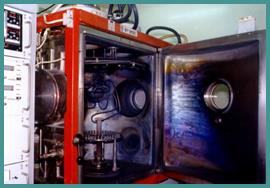 Point
2. A new hard coating deposition system having a large (700 x 700 x
700) mm coater box configuration was developed in INOE. The system which offers
facilities for larger substrates coating (even real industrial tools or
workpieces) is provided with 4 plasmatrons (arc)
vapor sources. The substrates can be biased (up to 200 V) allowing very high
ionic current densities to assist thin films deposition. A special lateral port
(i.d. 200 mm) was designed to fit a HEIBE prototype. The set-up will allow some
unique features: the direct comparison of effects of ion bombardment at
different energies and fluences and also the possibility to design new
dedicated applications. The plasmatron deposition
system was developed with the financial support of INOE but the HEIBE contract
significantly stimulated the decision to develop it. The deposition is made in
vacuum for metallic thin films (i.e. Ti, Cr) or, if a reactive gas is
introduced in the deposition chamber, a hard coating of nitride may be obtained
(TiN, CrN). the photo of an
arc discharge in front of one cathode. There were obtained thin films of TiN and CrN deposited on
stainless steel SS304. There were obtained thin films of TiN
and CrN deposited on stainless steel SS304.
Point
2. A new hard coating deposition system having a large (700 x 700 x
700) mm coater box configuration was developed in INOE. The system which offers
facilities for larger substrates coating (even real industrial tools or
workpieces) is provided with 4 plasmatrons (arc)
vapor sources. The substrates can be biased (up to 200 V) allowing very high
ionic current densities to assist thin films deposition. A special lateral port
(i.d. 200 mm) was designed to fit a HEIBE prototype. The set-up will allow some
unique features: the direct comparison of effects of ion bombardment at
different energies and fluences and also the possibility to design new
dedicated applications. The plasmatron deposition
system was developed with the financial support of INOE but the HEIBE contract
significantly stimulated the decision to develop it. The deposition is made in
vacuum for metallic thin films (i.e. Ti, Cr) or, if a reactive gas is
introduced in the deposition chamber, a hard coating of nitride may be obtained
(TiN, CrN). the photo of an
arc discharge in front of one cathode. There were obtained thin films of TiN and CrN deposited on
stainless steel SS304. There were obtained thin films of TiN
and CrN deposited on stainless steel SS304.
The
plasmatron coating deposition system developed in
INOE presented in the previous report, was improved by addition of a new
substrate holder, in order to apply on the substrates not only a dc bias
voltage (-100 V - 200 V) but also a pulsed bias voltage (max. 25 KV,
10 Hz, 10s). The substrate holder is vacuum tight, supports 25 kV and
max. 10 A discharge current and can rotate around its axis (in order to obtain
a better uniformity of the coating).
��������������� A multilayer structure (TiC, TiCN and TiN)
was deposited using a plasmatron discharge in
reactive atmosphere (containing C6H6, C6H6 + N2 and N2 for different stages of
the deposition process), using the above described pulsed and dc biasing of the
substrates.
��������������� Multilayers coatings, used in a
wide range of applications (e.g. optical, electronic, magnetic, corrosion
protection and wear / tribological) generally exhibit high hardness and good
adhesion to the substrate, good oxidation resistance properties, which are
impossible to obtain with monolayers. In the isostructural multilayers, due to
the crystallographic match of the neighbouring layers, special tribologic and hardness properties may be exhibited. TiN and TiC form one with another
stable solutions, in the full range of concentration of the constituent
elements. This enables to obtain Ti(CxN1-x) with the
lattice constant values ranging gradually from 0.424 nm (TiN)
up to 0.433 nm (TiC), depending on the mutual
proportions between nitrogen and carbon in the coating.
��������������� The used PVD type coating is a
cathodic arc in reactive plasma deposition (plasmatron
with dc bias voltage). Plasma source ion implantation (PSII plasmatron
with pulsed high voltage bias) was applied in the final stage of TiN deposition. In the case of PSII the plasma from the plasmatron discharge is used as well a source of medium
energy ions for implantation and of low energy ions for ion assisted deposition
(IAD).
������������������������������� The substrates
used were high speed steel ISO HS 6-5-2 (0.88% C, 4.2% Cr, 6.5% W, 5.0% Mo,
1.9% V), hardness 62 2 HRC. Different layers where
obtained for different ratios of the C6H6 /N2 reactive gases and different bias
parameters.
��������������� The X ray diffraction spectra
showed a gradual change in the lattice parameter values as the composition of
reactive atmosphere changes from pure N2 to C6H6.� Changing the dc bias value in the range 50 V
- 200 V a more pronounced (111) plane orientation in comparison with (200) and
(220) was observed for both TiN and TiC specific lines. The applied high voltage bias substrate
determined a densification of the deposited film and a finer texture with finer
crystallite dimensions, determining a higher hardness of the film. When high
voltage bias was applied TiN, TiC
and Ti specific X-ray diffraction lines were observed, probably due to the
destruction of� Ti
- C bonding due to the bombardment with medium energy ions.�
��������������� For the deposited layers,
microhardness ranging from 2400 HV (0.5) to 3500 HV (0.5) where obtained.
Scratch tests showed that there is a critical force of adhesion Fc for every
layer / substrate: TiN/ Ti(CxN1-x),
Ti(CxN1-x)/ TiC and TiC/
HSS. The best adhesion (higher Fc) was obtained for TiN/
Ti(CxN1-x) and the lower one for TiC/
HSS. The best results were obtained for the high content of nitrogen (10% -
30%) in the mixed reactive deposition atmosphere. The critical force values
obtained were in the range of 55 N - 68 N, compared with the usual values of
about 45 N for TiN thin films previously deposited.
Point
3.� Due to the existing
experience related to hard coatings deposition some tests of coated electrodes
for HEIBE system are in development. These tests are aimed to improve the lifetime
of highly stressed electrodes surfaces during high power switching in the pulse
formation devices.
Another contribution of INOE - Low Energy Ion Beam Laboratory to
the development of a new HEIBE system in LPMI Palaiseau
was the mass spectrometric leak control of the vacuum chamber manufactured by
N&V.�
Point
4. Being a milestone of the contract, the development of a
reliable, high speed e-mail/internet link was very
seriously considered by INOE. The existing Copernicus HEIBE contract triggered
the development of a new e-mail/internet link connecting the laboratory and than the whole INOE network by high
speed microwave communication system directly to the satellite link
installed in the Polytechnical University in Bucharest. In the third and last
year of activity for the present contract the data base software developed in
INOE was completed with a�
number of� 500 papers
related to the high energy ion beam modification of surfaces. The main
information (titles, authors, key words, journal, abstract) is stored in
computer and may be easily accessed using the new created DataBase-INOE.
Point
5. In this first year having internet facilities and travel expenses
ensured by the contract, approx. 300 papers related to the above
mentioned topic were collected. The main information (titles, authors, keywords,
journal) is stored in computer and may be easily accessed. Also, the created database
made possible to find out about some books recently published, related to thin
films deposition in vacuum by PVD techniques and surface processing in plasma
or with ions. They were purchased from other financial sources.
As
a result of the already existing data base, a short review of literature
related to �Material Aspects of Corrosion Protection by Ion� Beam Techniques� is presented in
annex1 and annex 2.
���������������
Point
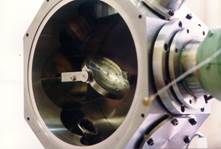
6� Substrate
holder designed and manufactured.
Publications
and papers
�
Modified dc magnetron sputtering
configuration investigated by optical emission spectroscopy and related TiN films properties, V.Braic,
M.Braic, G.Pavelescu, C.N.Zoita, G.Musa, Balkan Phys.
Lett, vol. 6/7 1997
�
Influence of He, Ne and Kr
addition in reactive Ar/N2 dc magnetron
plasma on TiN thin films, M.Braic, C.N.Zoita, V.Braic, A.Kiss, M.Popescu, G. Musa, Vacuum, 53 (1-2) , pp.41-45.
�
Langmuir probe investigation of a
plasma produced in a dc magnetron system, V.Braic,
M.Braic, C.N.Zoita, A.Kiss, Rom.Rep.Phys., vol. 49,
nr.5/7, 1997
�
Magnetron discharge - dedicated
spectroscopic investigation for TiN thin films
deposition, M.Braic, V.Braic, C.N.Zoita, A.Kiss, Rom.Rep.Phys., vol. 49,
nr.5/7, 1997
�
������ Carrier
density and temperature measurement in a pulsed hydrogen plasma generated by a duopigatron ion source, V.Braic, C.Zoita, A.Kiss, M.Braic, G.Pavelescu, Rom.J.Optoelectronics,
vol.6, 4. p. 13-16 (1998)
�
M. Balaceanu,
E. Grigore, G. Pavelescu, F. Ionescu , J. P. Roger,
Optical characteristics of carbon nitride films prepared by hollow cathode
discharge, J.Optoelectronics and Advanced Materials,
Vol.2, N0.4, Dec 2000, p351
�
M.Balaceanu,
E.Grigore, F.Truica-Marasescu, D.Pantelica, F.Negoita, G.Pavelescu, F.Ionescu, Characterization of carbon nitride films
deposited by hollow cathode discharges process,�
Nucl. Instr. & Meth. Vols. 161-163, March
2000, p 1214
�
J. Larour,
P. Choi, J. Rous, S. Dine, S.L. Yap, C.S. Wong, G. Pavelescu
, M. Favre, A. Guilbert, Ion Beam Measurements on a Modified Plasma
Focus, APS Plasma Physics meeting, October 25, 2000, Canada.
�
P.Choi,
J.Larour, G.Pavelescu, V.Braic, C.Dumitrescu, M.Braic, J.Rous, Effect of
Irradiation with Pulsed Nitrogen Ions� of
TiN Coated Austenitic, ROCAM 2000
�
Influence of noble gas addition in
low frequency driven magnetron discharge for TiN thin
films deposition, M.Braic, C.N.Zoita, V.Braic, A.Kiss, G. Musa, VI-th European
Conf. on Atomic and Molecular Physics, ECAMP �98, Siena. Italy, July 1998
�
Plasma diagnosis of a low
frequency driven magnetron, V.Braic,
C.N.Zoita, M.Braic, A.Kiss, G.Musa, X-th Conference on Plasma Physics and Applications, Iasi,
Romania, June 1998
�
Influence of He addition in
reactive dc magnetron plasma for TiN thin dilms deposition, M.Braic,
C.N.Zoita, V.Braic, A.Kiss, G.Musa, X-th Conference on Plasma Physics and Applications, Iasi,
Romania, June 1998
�
Langmuir probe diagnosis of a
pulsed duopigatron ion source, V.Braic, C.N.Zoita, A.Kiss, M.Braic, X-th Conference on Plasma Physics and Applications, Iasi,
Romania, June 1998
�������������� Influence of a pulse superimposed
on a dc reactive�
magnetron plasma for TiN thin films
deposition, M.Braic, V. Braic,
C.Zoita, A.Kiss, 18-th
General Physics Conference of the Turkish Physical Society, October 1998,
Alanya, Turkey
�������������� Influence of the added He and Ne
to N2 on the barrier discharge emitted N2(B-X) band
�G.Musa,
I.Borcoman, E. Finantu, C.Bob-Surdu, M.Andrei, M.Braic, ESCAMPIG 14, Malahide, Ireland, European
Conference Abstracts, Vol. 22H, p.88-89, ed. D.Riley,
C.M.O. Mahony, W.G. Graham, Belfast 1998
�������������� Gas Nature Influence on the
Langmuir probe Characteristics in a Pulsed Duopigatron
Ion Source,� 18-th
General Physics Conference of the Turkish Physical Society, October 1998,
Alanya, Turkey
�������������� Dependence of the hard coatings
properties on the substrate geometry and dimensions M.Balaceanu, G.Pavelescu, A.Manea, A.Popescu, E.Grigore, F.Marasescu-Truica,
5th Int. Union of Materials Research Societies - Int. Conf. in Asia (5th
IUMRS-ICA-98), India
�������������� Influence of ion bombardment on
amorphous carbon (a - C) film characteristics M.Balaceanu, E.Grigore, G.Pavelescu, F.Truica-Marasescu, G.Galeata, V.Braic, Xth Conference on Plasma Physics and
Applications, June 1998, Iasi, Romania